
 English
  Suomi
Suomi  Norsk bokmål
  Svenska
  Lietuvių kalba
  Latviešu valoda
  Polski
  Русский
  Deutsch
  Eesti
Eesti  Nederlands
iGrip SS · A practical guide for farming
iGrip SS studs
for tractor tires.
Choose the right fit.
Our iGrip SS screw-in tire studs help tractors gain traction on ice and packed snow. Compare stud sizes, calculate your quantity and follow our installation guide for farming.
01 / Start with the tire
Measure tire tread depth.
Allow 2 mm clearance.
Minimum tread depth equals the stud's penetration depth plus 2 mm. Measure the remaining tread height at the intended installation points. Select studs by these measurements, block width and rubber condition, rather than tractor size.
- Clean and inspect the tread block.Remove dirt and stones. Choose sound rubber with no cracks or tears.
- Measure from the bottom of the groove.Use a tread depth gauge or ruler to measure up to the top of the tread block.
- Check several points.Repeat around the tire and on different blocks. Use the lowest reading from your intended installation points to select the model.
- Check front and rear tires separately.Record the tire make, model, size and measured tread height. Check the block width too.
Our selection rule
Minimum tread depth
= penetration depth + 2 mm
We add the 2 mm allowance to the length that enters the tire. For example, SS-30 penetrates 28 mm, so it needs at least 28 + 2 = 30 mm of tread. Its overall length is 32 mm, with 4 mm above the rubber.
02 / Find your SS model
Choose your iGrip SS model.
Use actual tread depth.
Compare SS-15, SS-18, SS-25, SS-30, SS-40 and SS-50 using the table and selector below. Enter your lowest measured tread depth. We suggest models whose minimum tread requirement is met and is no more than 10 mm below your measurement. For example, 40 mm of tread gives SS-40 and SS-30.
We consider all six SS models. For example, for 40 mm of tread, we suggest SS-40 or SS-30.
| Model | Overall length | Into the tire | Above the rubber | Minimum tread depth (penetration depth + 2 mm) |
|---|---|---|---|---|
| SS-15 | 16 mm | 13 mm | 3 mm | 15 mm |
| SS-18 | 20 mm | 17 mm | 3 mm | 19 mm |
| SS-25 | 27 mm | 23 mm | 4 mm | 25 mm |
| SS-30 | 32 mm | 28 mm | 4 mm | 30 mm |
| SS-40 | 42 mm | 35 mm | 7 mm | 37 mm |
| SS-50 | 52 mm | 45 mm | 7 mm | 47 mm |
Model numbers are product names, not exact overall lengths. Compare overall length, penetration and protrusion separately. Also check block width, rubber condition and working conditions. These dimensions cover SS models without R or HD suffixes.
Why do we recommend SS for tractors?
Why choose SS studs?
The support shoulder.
Our SS (Shoulder Stud) studs have a wide support shoulder. It spreads the load through the rubber and helps prevent the stud from sinking deeper.
Stud without a support shoulder
Under load, a stud body without enough support may sink deeper. This makes its head harder to reach with the removal tool.
iGrip SS with a support shoulder
The support shoulder is seated in the rubber, with its top flush with the rubber surface. This limits sinking. Recesses in the shoulder ring allow the tool to engage for easy stud removal.
Schematic diagrams, not to scale. Correct model selection and installation depth are essential.
Tungsten carbide tip
The wear-resistant working tip helps provide grip on ice and packed snow.
Secure anchoring
The coarse thread anchors into suitable rubber. Hardened, zinc-plated steel gives the body strength and corrosion protection.
Accessible for removal
Recesses in the SS shoulder ring allow the tool to engage even when the hexagonal head is worn.
Take a closer look at the SS design
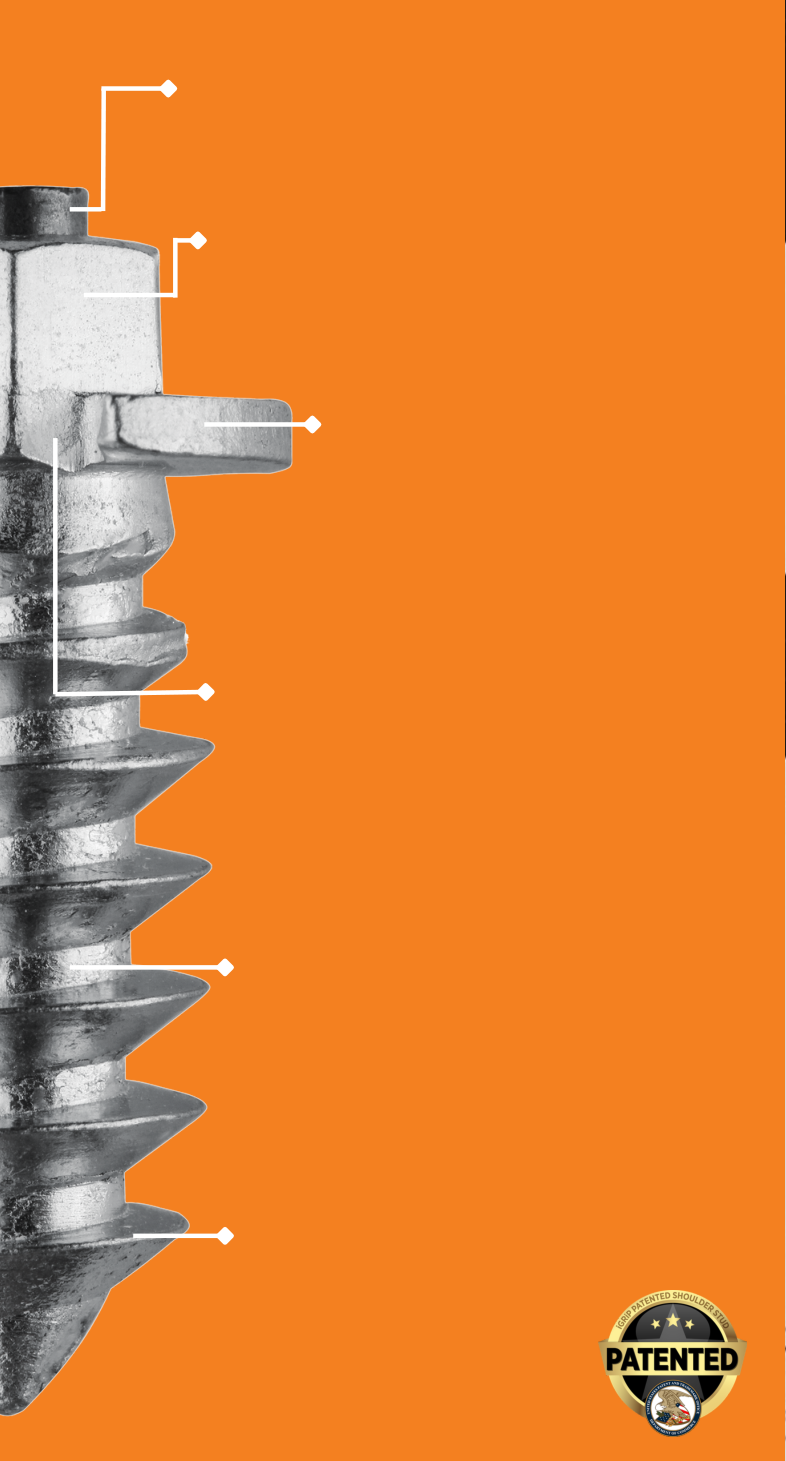
Tungsten carbide core through the full height of the hexagonal head
Hexagonal profile for added grip
Wide support shoulder limits excessive penetration
Special shoulder-ring recesses for easy removal
Induction-hardened, zinc-plated steel
Special coarse thread
03 / Calculate your quantity
Calculate tire stud quantity.
Plan each tire separately.
Studs per tire = tread blocks to be studded × studs per block. Count blocks on both sides of the tire. For more grip, use more studs where block dimensions allow. When using fewer studs, distribute them evenly around the tire.
- Mark the first block.Work around the entire tire and count each physical block only once.
- Add both sides.If there are 17 blocks on one side and 17 on the other, you have 34 blocks in total.
- Choose your layout.We show examples with 2–4 studs per agricultural tread block. Adjust the quantity to the block size, tire and job.
One simple formula
Blocks × studs per block × tires = total quantity
Example: 34 blocks × 4 studs = 136 studs per tire. For two identical tires, the total is 272.
Front tires
Group of identical tires
Rear tires
Group of identical tires
Front: 168 · Rear: 272
These are arithmetic examples for a single tire with 34 blocks. They are not universal categories for “light”, “standard” or “maximum” grip. The range of 100–150 studs per tire is a rough guide; your own calculation determines the order quantity.
When the number of studs varies between blocks
Add the groups separately. For example, 17 blocks with 2 studs and 17 blocks with 4: (17 × 2) + (17 × 4) = 102 studs per tire. Do not count small winter tread blocks as if they were large agricultural lugs: count the actual planned installation locations.
If tires on the same axle differ, or you use dual wheels, calculate each different tire separately and add the results. Each calculator group must have the same block count and stud layout.
04 / Plan the installation points
Where to place tire studs.
Keep the pattern even.
Start with the outer tread blocks on both sides of the tire, then distribute the remaining studs across the center of the tread. Balance both sides and repeat the pattern evenly around the tire. Stagger positions in neighboring blocks, leaving enough sound rubber around each stud.
Block shape matters more than tractor size
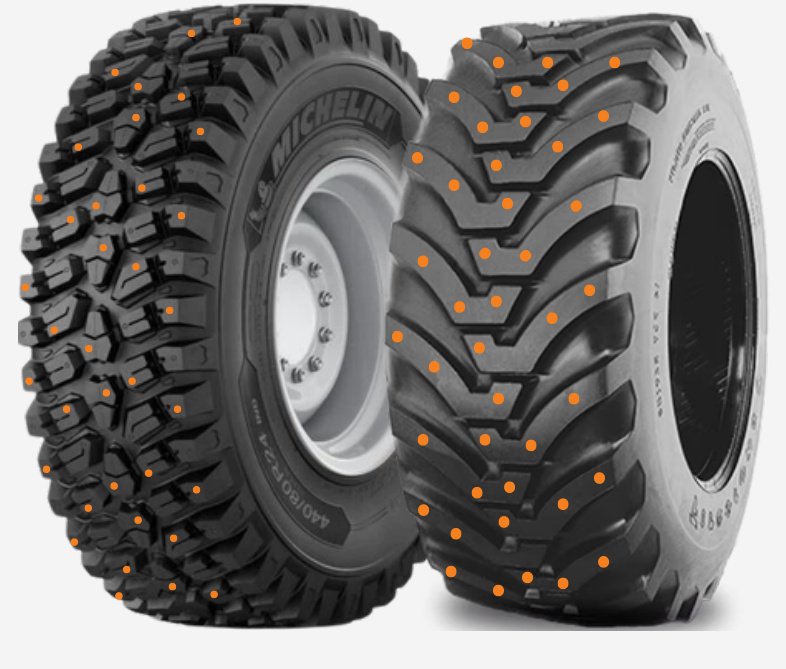
An industrial tire on a small tractor and an agricultural tire on a large tractor may have completely different tread patterns. Adapt the layout to the actual rubber shape.
- Leave enough sound rubber around the thread and shoulder.
- Balance the left and right sides.
- Repeat the pattern evenly around the entire tire.
- Mark the positions before driving in any studs.
We do not specify one spacing in millimetres for every tire. If the block is narrow or its shape is unclear, send us a photo with measurements.
Agricultural tires
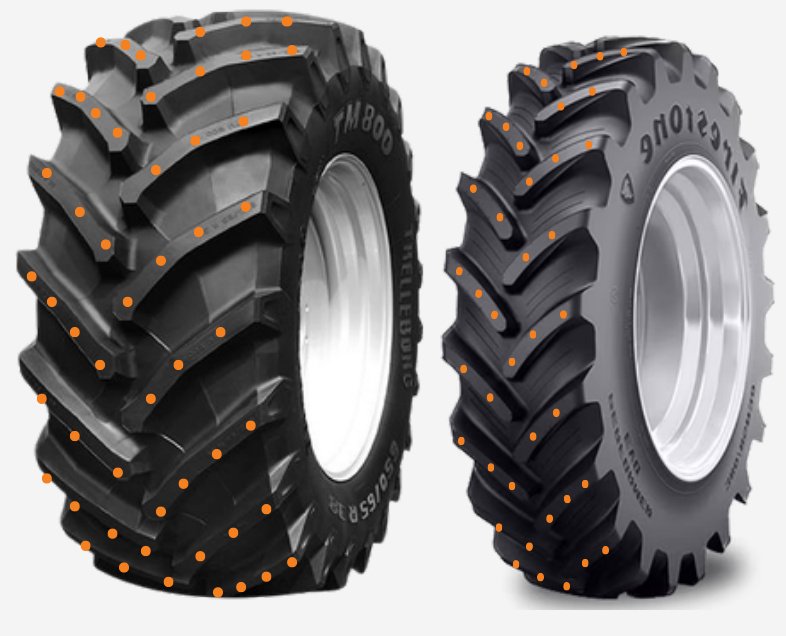
Winter and industrial tires
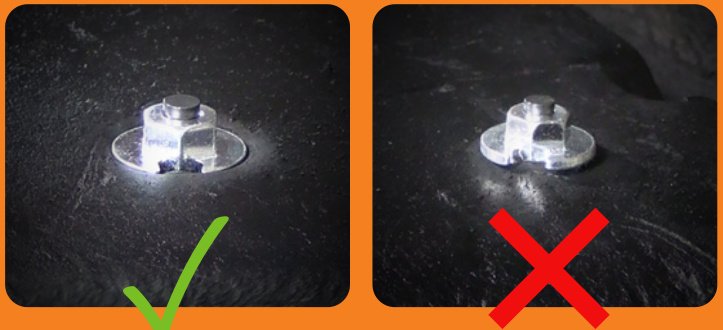
✓ Suitable locations
- Main working tread blocks.
- Sound rubber with sufficient height and width.
- A balanced, repeating pattern.
× Unsuitable locations
- Tire sidewalls or the bottom of grooves.
- Torn, cracked or overly worn blocks.
- Positions too close to a block edge, with insufficient surrounding rubber.
05 / Install step by step
How to install iGrip SS studs.
Start with one stud.
Every pack includes a dedicated iGrip installation tool; replacements are also available separately. Prepare your chosen studs, the matching tool, a drill/driver, a tread depth gauge and a marker. Keep the diagram for your exact SS model at hand.
Measure
Clean the tread. Measure block height at several points and record the lowest reading. Check front and rear tires separately.
Choose your SS model
Check that tread depth ≥ penetration depth + 2 mm. You also need sufficient block width and sound rubber. Use the installation instructions for your exact model.
Plan the whole tire
Count the blocks and mark the positions. Start with the outer tread blocks on both sides, then distribute the remaining studs across the center. Stagger the pattern and repeat it evenly around the entire tire.
Prepare the tool and installation point
Park the tractor safely, switch off the engine and secure it against movement. Fit the correct iGrip tool for your SS model to the drill/driver. For SS-40 and SS-50, follow the additional preparation below.
Drive in perpendicular to the block
Start with one stud. Hold the tool at 90° to the tread block surface at the installation point and drive it in with controlled rotation. Keep the stud straight.
Stop at the correct position
Seat the support shoulder in the rubber until its top is flush with the rubber surface. The shoulder must not protrude. Stop at this position and check the working tip protrusion specified for your model.
Check and complete
Check protrusion against the model-specific diagram. Inspect the rubber, alignment and anchoring. If the first stud is correctly installed, complete the pattern and inspect the whole tire.
SS installation dimensions and preparation
Minimum tread depth = penetration depth + 2 mm. Overall length, penetration depth and protrusion are shown separately below.
Install SS-30 directly with the correct iGrip tool. Seat the support shoulder in the rubber until its top is flush with the rubber surface.
 Open our SS-30 installation diagram ↗
See the full process
How to install SS-30 tire studs
Watch tool positioning and the installation process in our video guide. This video covers SS-30.
Clicking the video loads the YouTube player. If it does not open, watch the instructions on YouTube ↗.
06 / Removal and maintenance
How to remove and reuse SS studs.
The tool-engagement recesses are on the SS shoulder ring. The tool’s teeth fit into these recesses, allowing removal even when the hexagonal head is worn.
1. Fit the tool
Clean the recesses in the shoulder ring. Place the iGrip tool for your SS model around the head and fully seat its teeth in the ring’s recesses.
2. Select reverse
Keep the tool aligned with the stud. Turn counterclockwise in a controlled manner without letting the tool slip.
3. Remove and inspect
Inspect the thread, body and carbide tip. Reuse only studs in suitable condition, in a suitable area of sound rubber.
A tractor owner’s experience
SS-40 at the rear. SS-30 at the front.
“…they stick like glue to hard ice.”
NSMaple1 · Nova Scotia, Canada · 21 March 2021
The user described fitting SS-40 to the rear tires and SS-30 to the front tires. After several months of use, they reported good grip on hard ice.
Read the original ArboristSite post, No. 22 ↗
Before you begin
iGrip SS tire stud questions
Can I install iGrip SS studs myself?
Yes. Every pack includes a dedicated iGrip installation tool. If you lose it, replacement tools are also available to buy separately. Use the tool with a drill/driver and follow the installation instructions for your model. First assess the tire and try one installation point. SS-40 and SS-50 require additional preparation.
How deep does the tread need to be?
Our rule is that tread depth must be at least 2 mm greater than the length entering the tire. SS-15 needs at least 15 mm, SS-18 19 mm, SS-25 25 mm, SS-30 30 mm, SS-40 37 mm and SS-50 47 mm. Measure the remaining tread height at the intended installation point.
Does tractor size determine the stud model?
No. We select the model by measured tread depth, block width and rubber condition. The same tread measurement gives the same selection result on a small or a large tractor.
Why do we suggest SS-40 and SS-30 for 40 mm of tread?
SS-40 needs at least 37 mm of tread and SS-30 needs 30 mm. These requirements are 3 mm and 10 mm below the measured 40 mm, so both models qualify. The minimum requirements for SS-25, SS-18 and SS-15 are more than 10 mm below the measurement, so we do not suggest them. SS-50 needs at least 47 mm, so there is not enough tread for it.
How many studs do I need per tire?
Count all the tread blocks you intend to stud and multiply by the chosen number of studs per block. For example, 34 blocks with 4 studs each require 136 studs per tire. The 100–150 stud range is a rough guide and does not apply to every tire. For more grip, use more studs. If you use fewer studs, distribute them evenly around the tire for consistent grip. We recommend studding the outer tread blocks on both sides first, then distributing the remaining studs evenly across the center of the tread.
Do I need to stud all four tires?
Front and rear tire grip supports different tasks: steering, traction and braking. Choose which tires to stud according to the tractor’s drivetrain, use and working conditions. If you are unsure, send us the tire details for both axles.
Can I fit studs to used tires?
Yes, if enough tread remains and the rubber at the installation points is sound. Cracked, torn or badly damaged blocks are unsuitable. Check actual measurements, not catalogue specifications for a new tire.
Can a stud damage the tire?
A stud that is too long, poorly positioned or incorrectly installed can damage the tire. The SS support shoulder limits sinking, but the correct model and installation remain essential. Follow the +2 mm selection rule and the model-specific installation dimensions.
Do all SS models require drilling?
No. SS-15, SS-18, SS-25 and SS-30 are installed directly. SS-40 requires drilling. The separate SS-50 diagram specifies drilling and a drop of adhesive. Check drilling dimensions, adhesive type and preparation in the instructions for your model.
Can the support shoulder protrude above the rubber?
No. The shoulder must be seated in the rubber with its top flush with the rubber surface. A protruding shoulder means the stud has not been driven in far enough. Only the working part specified for that model should remain above the rubber.
Can SS studs be removed and reused?
Yes. Use the correct iGrip tool with the drill/driver set to reverse. Recesses in the shoulder ring help the tool engage even when the hexagonal head is worn. Check the stud and tire rubber before reuse; do not reinstall damaged studs.
Do these dimensions apply to R and HD versions?
This guide covers SS-15, SS-18, SS-25, SS-30, SS-40 and SS-50 without R or HD suffixes. For any other version, use its own dimensions, installation tool and instructions.
We can help you choose
Send us your tire details. We will help you find the right fit.
Tire make, model and size · tread depth · block count · tractor model · intended use · photos of the tire and tread blocks.
iGrip Europe
info@igripstud.eu
+370 525 55650
Your email app will open with the enquiry ready to edit and send. You can add tire photos alongside the calculator results.